PROJECT
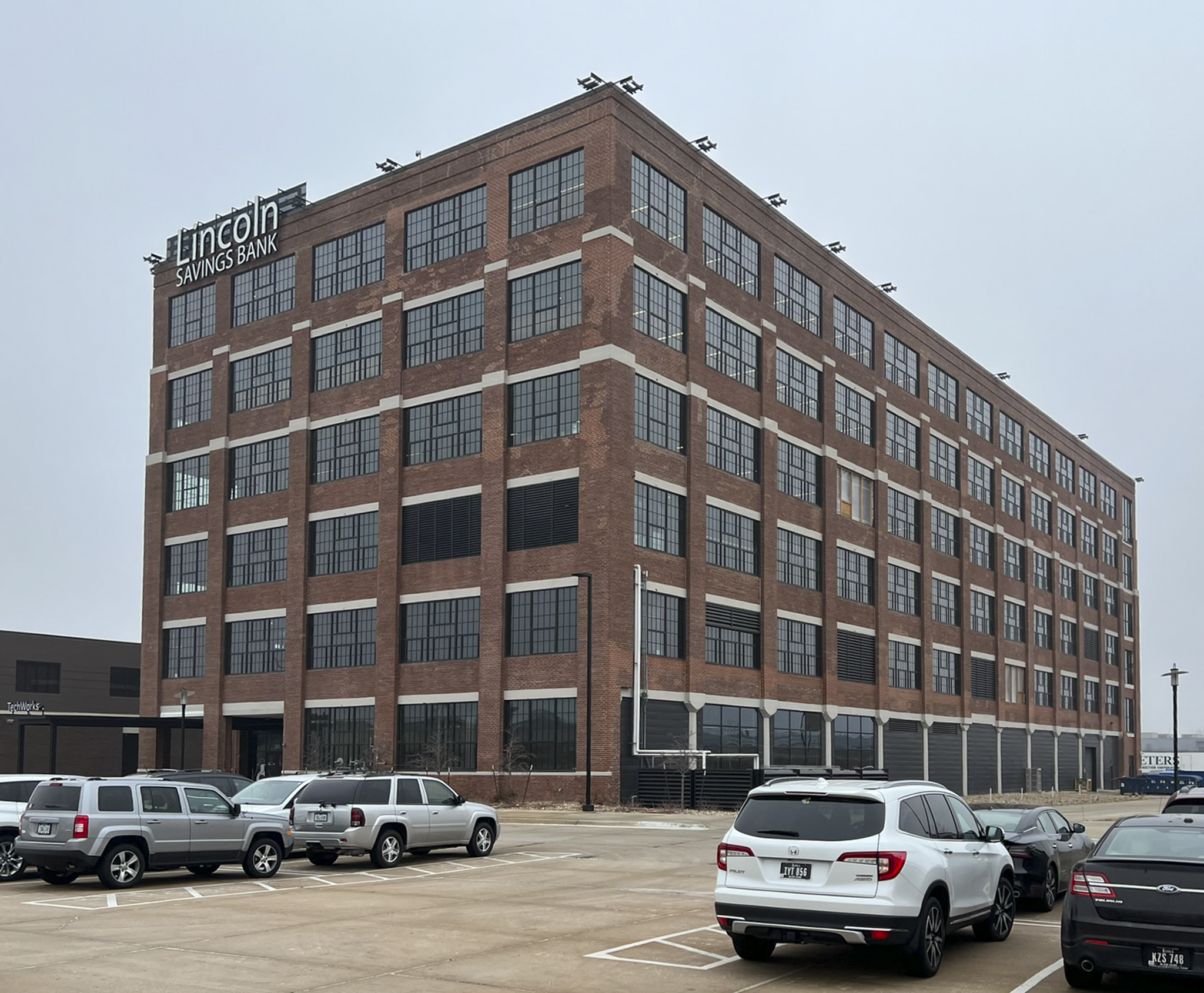
When Lincoln Savings Bank set out to establish its first-ever central headquarters, the John Deere Tractor Company building at Waterloo's TechWorks campus was a natural choice — steeped in industrial history, architecturally distinctive, and eligible for historic tax credits that made the adaptive reuse financially compelling.
The century-old warehouse building brought with it the bones of a headquarters worth having: exposed brick, heavy timber, and the kind of material authenticity that no new construction can replicate. It also brought preservation requirements that made the HVAC challenge genuinely difficult.
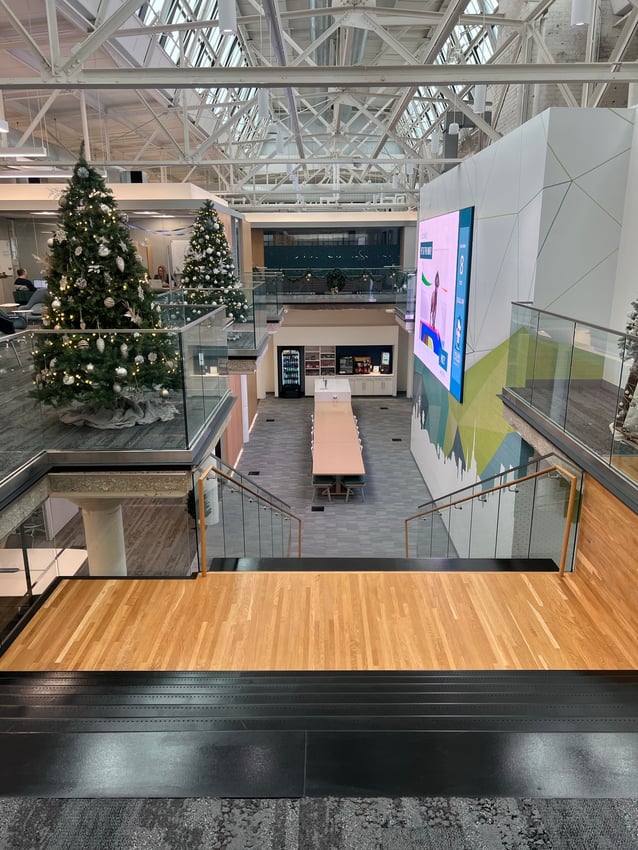
The project occupies the building's top two floors. A dramatic design intervention early in the project set the tone for what followed: to capitalize on a massive boarded-up skylight on the upper level, the architects removed a 1,700 SF section of the 12-inch-thick concrete floor between the fifth and sixth levels — a significant structural undertaking — creating a grand two-story entry and central staircase flooded with natural light. The result is an interior that feels unexpectedly open for a converted warehouse, anchored by the skylight above and finished with laminated timber, glass railing, micro-perforated oak paneling, felt acoustic panels, and sleek black fixtures throughout.


.jpeg?width=1200&length=1200&name=IMG_3315%20(1).jpeg)
PROJECT ASK
Historic preservation guidelines governed every material decision from the exterior skin inward. The original ceilings and walls were protected — they could not be altered, penetrated, or obscured. This single requirement eliminated the entire category of conventional overhead HVAC solutions: no ductwork, no VAV boxes, no diffusers, no supply or return grilles in the ceiling plane.
The challenge for Modus Engineering and Invision Architecture was to deliver a modern Class A office environment — individual thermal comfort control, consistent air quality, energy efficiency, acoustic performance — within a building whose defining architectural surfaces were entirely off-limits to mechanical penetration.
The solution was a raised access floor system, which moved the entire mechanical, electrical, and HVAC infrastructure to the underfloor plenum. This approach preserved the original ceilings completely while creating an infrastructure layer that could be accessed, maintained, and reconfigured without touching the historic fabric of the building above.
“One of the things that I love about working in existing buildings is the opportunity to breathe new life into something that’s tired.”
AIRFIXTURE SOLUTION
AirFixture supplied a fully integrated UFAD system across both floors, coordinated with a centralized air handling unit sized and located to minimize the mechanical room footprint within the historic structure.
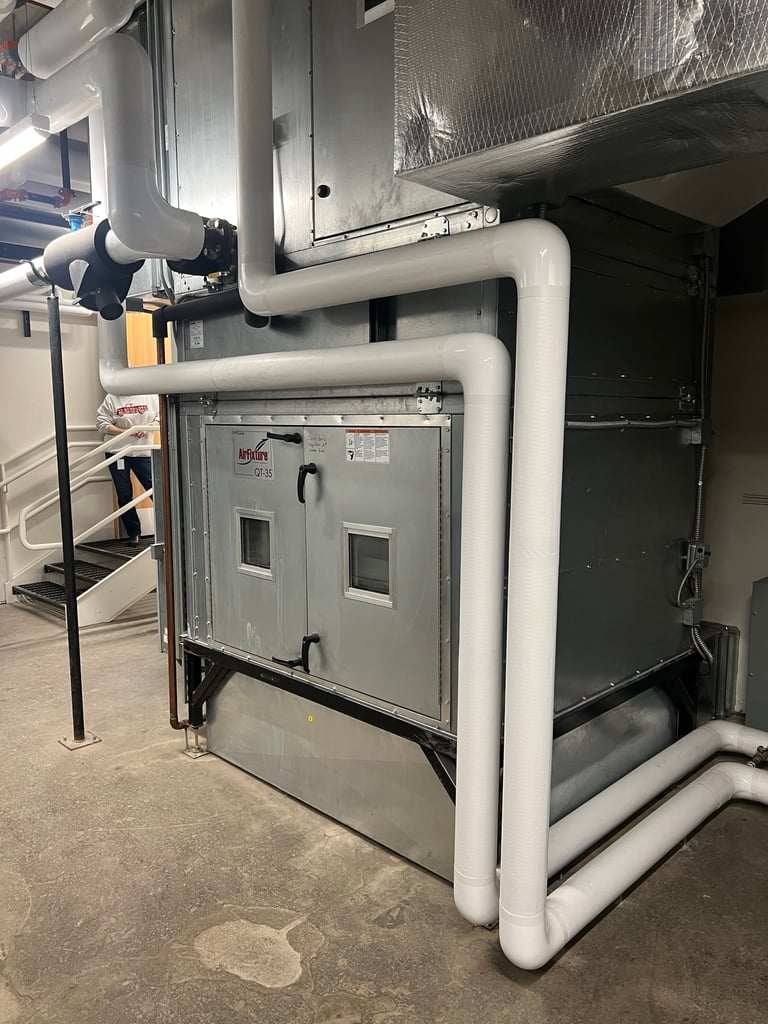
QT-35 Air Handling Unit serves as the central distribution core for the system. Its compact design reduces the equipment footprint and mechanical room size — a critical advantage in a building where every square foot of floor area has historic significance and operational value. The unit features a mounted control system and third-party factory-verified low sound output, keeping the system acoustically compatible with a quiet professional office environment.
PCD-10SVAV-C Variable Volume Personal Comfort Diffusers are distributed throughout the open office area, providing occupant-level supply air directly from the underfloor plenum. Each diffuser sits flush with the floor surface and is paired with an individual thermostat, giving occupants direct control over their personal comfort zone — a feature that contributes measurably to occupant satisfaction in open-plan environments. The variable air volume design adjusts supply based on real-time zone demand, preventing the hot and cold spots that plague fixed-volume overhead systems in large open floors.
All products are finished in sleek black to complement the project's industrial-modern aesthetic — matching the glass railing, micro-perforated oak paneling, and hardware finishes throughout the headquarters.
CLWMIT Continuous Linear Hydronic Trench Heaters line the perimeter of the fifth floor, using building hot water to create a continuous thermal boundary along the building envelope. This perimeter heating strategy is particularly well-suited to a historic warehouse building with significant exterior wall exposure and original single-pane-era glazing details.
SoHo-e Electric Fan-Powered Linear Trench Heaters serve the sixth floor perimeter, providing a complementary electric solution at the upper level where the two-story atrium and skylight opening introduce additional thermal complexity.
All products are finished in sleek black to complement the project's industrial-modern aesthetic — matching the glass railing, micro-perforated oak paneling, and hardware finishes throughout the headquarters.
RESULTS
The completed headquarters delivers what the preservation brief demanded and the occupants require: the historic character of the John Deere Tractor Company building is fully intact — original ceilings clear, brick walls unaltered, skylight restored and opened into the space — while the two occupied floors perform as modern Class A office space with individual comfort control, reliable air quality, and energy-efficient perimeter conditioning.
In 2021, the Association of Licensed Architects honored the project with its Commercial/Industrial Gold award. The headquarters also received the 2023 AIA Central States Merit Award.
Looking to bring modern HVAC into a historic space- without compromising the character? Contact us today.