Advantages of Underfloor Air Distribution: Ladder & Maintenance Safety
Discover how underfloor air distribution systems (UFAD) reduce ladder use and simplify HVAC installation and maintenance.
Floor, wall and ceiling mounted to meet your unique project design.
6 min read
AirFixture : Apr 7, 2026, 11:14:22 AM
LEED v5 represents a fundamental shift in the world's leading green building rating system- from prescriptive, component-based requirements to a performance-driven framework centered on deep decarbonization, indoor air quality (IAQ), and occupant well-being. While LEED v5 refrains from mandating specific technologies, its new prerequisites and credit structures strongly favor building systems that inherently align with these performance goals.
We posit that Underfloor Air Distribution (UFAD) is one such system. Through analysis of key LEED v5 credits related to operational carbon, peak thermal loads, ventilation effectiveness, and occupant satisfaction, UFAD’s core principles—buoyancy-driven airflow, reduced static pressure, and individualized control—provide a strategic and technically sound pathway to achieving strong results under the new rating system.
The U.S. Green Building Council's (USGBC) release of LEED v5 marks a significant evolution of the world’s most widely used green building rating system. The update formalizes a commitment to tangible, measurable outcomes, organizing the system around three overarching impact areas: Decarbonization, Quality of Life, and Ecological Conservation & Restoration. Key changes include:
This new version demands that all building systems, particularly HVAC, prove their value not just in energy savings, but in their contribution to decarbonization, health, and resilience. As such, design teams must now seek out technologies that offer synergistic benefits across multiple performance metrics. UFAD is one of the few HVAC strategies uniquely aligned with LEED v5’s performance-based framework.
UFAD is an HVAC system that utilizes a pressurized plenum created by a raised access floor to deliver conditioned air at low velocity directly into the occupied zone. Unlike traditional overhead systems that rely on a mixing process, UFAD leverages the principle of thermal stratification and buoyancy-driven airflow.
These technical characteristics position UFAD as a strong candidate for LEED v5 projects seeking verified performance across energy, IAQ, and occupant experience metrics.
A detailed examination reveals that UFAD's functional attributes align with and directly contribute to the achievement of multiple, high-value credits across the LEED v5 rating system.
In alignment with the decarbonization goals of LEED v5, the point allocation for the Materials and Resources credits has increased, underscoring the growing importance of tracking and reducing embodied carbon in building materials and construction practices. A trusted raised access floor manufacturer has 3rd party verified environmental documentation including Environmental Product Declarations (EPD) that support the whole building Life Cycle Assessment and can contribute to multiple credits in the category.
While UFAD offers significant advantages, successful integration within the LEED v5 framework requires careful planning and execution. The project team must ensure:
LEED v5 challenges the building industry to move beyond prescriptive calculations and deliver truly high-performance buildings that address the climate crisis and public health. This shift to a performance-centric version fundamentally changes the calculus for selecting building systems.
Underfloor Air Distribution is not a required component in LEED v5, but its intrinsic functional principles provide a powerful and direct solution to the new rating system’s most demanding requirements. From reducing operational carbon by lowering fan energy and improving heat pump efficiency, to providing verifiable ventilation and enhancing occupant well-being, UFAD acts as a strategic lever that drives performance across multiple categories. In a world where every kilowatt-hour and every breath of air is a metric to be measured, UFAD’s ability to deliver tangible, quantified benefits makes it an ideal technology for projects aiming to achieve LEED Platinum. In LEED v5, success is defined by measurable outcomes—not prescribed systems. UFAD stands out as a rare HVAC strategy that delivers across carbon, air quality, and occupant experience simultaneously. For project teams targeting high-performance outcomes, it is not just a viable option—it is a strategic advantage.
[1] Wu, Y.-C., Hsu, H.-C., Wang, H.-Y., & Pan, C.-Y. (2025). “Field Evaluation of Thermal Comfort and Cooling Performance of Underfloor Air Distribution Systems in Stratified Spaces.” Buildings, 15, 3241. https://doi.org/10.3390/buildings15173241.
[2] Webster, T., Bauman, F., Shi, M., & Reese, J. (2002). “Thermal stratification performance of underfloor air distribution (UFAD) systems.” UC Berkeley: Center for the Built Environment. Retrieved from https://escholarship.org/uc/item/6vv4g4d7
[3] Li, H., Cui, Q., Kong, X., & Fan, M. (2023). “Comparative Study on the Thermal Characteristics Under Different Air Distribution Strategies Oriented to Non-Uniform Environment: An Indoor Experiment.” Building and Environment, 246, 110982. https://doi.org/10.1016/j.buildenv.2023.110982
[4] ASHRAE Standard 62.1-2022. Ventilation for Acceptable Indoor Air Quality. American Society of Heating, Refrigerating and Air-Conditioning Engineers.
[5] Fisk, W. J. (2020). "Strategies to reduce indoor transmission of SARS-CoV-2 and other viruses." Building and Environment, 179, 106972.
[6] Fisk, W. J., Faulkner, D., Sullivan, D.P., Chao, C., Wan, M.P., Zagreus, L., & Webster, T. (2004). “Performance of Underfloor Air Distribution: Results of a Field Study.” Center for the Built Environment, University of California, Berkeley. https://escholarship.org/uc/item/9088399m
[7] Steven Winter Associates, Inc. (2020). "Embodied Carbon of Raised Access Floors." A study prepared for the Access Floor Industry Association.
.png)
Discover how underfloor air distribution systems (UFAD) reduce ladder use and simplify HVAC installation and maintenance.
How to Complete a UFAD Implementation Inspection
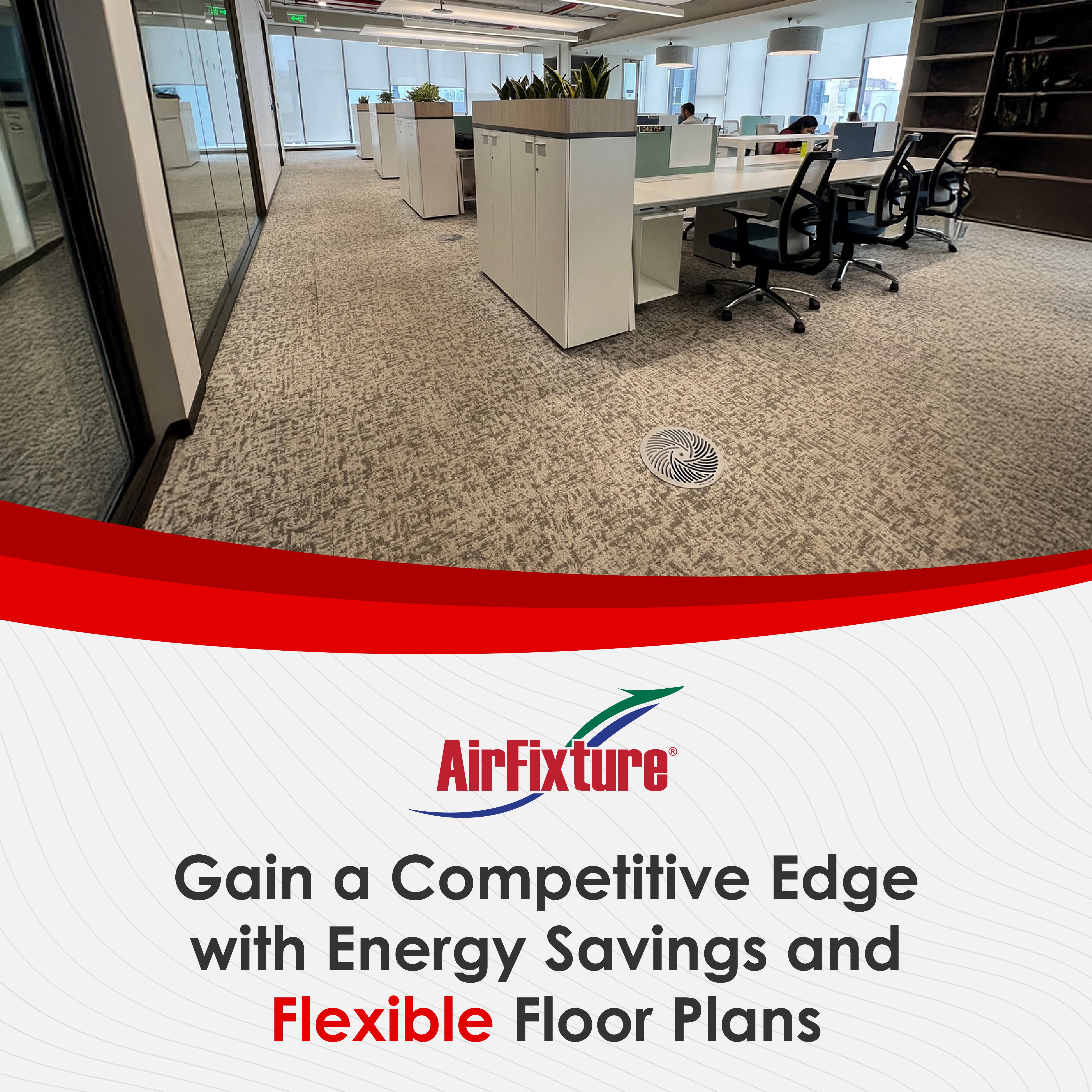
Discover how UFAD with RAF provides premium tenants with flexible, sustainable, and efficient office build-outs.