1 min read
What Are the UK's Legal Requirements for Air Conditioning?
Air conditioning legal requirements in the UK are put in place to ensure the health and safety of occupants in commercial buildings. Property...
2 min read
.png)
According to The Occupational Safety and Health Administration (OSHA), falls - including those from ladders-are the leading cause of workplace fatalities. Even non-fatal incidents, such as strains or slips during ladder use, can lead to downtime, insurance claims, and costly project delays. The National Institute for Occupational Safety and Health (NIOSH) estimates $24 billion of ladder-injury-related costs annually in the US, factoring in medical expenses, liability, lost productivity, and legal fees.
Traditional overhead HVAC systems require frequent ladder use to access ceiling vents, adjust dampers, or perform routine maintenance — often dozens or even hundreds of times over a system’s lifetime. The more ladder time required, the greater the risk. Falls from ladders also create ripple effects beyond immediate injuries. Projects can stall while investigations occur, and companies may face regulatory scrutiny or reputational damage. In industries where deadlines and budgets are critical, even minor ladder-related incidents can derail schedules, increase overhead costs, and strain relationships with clients and stakeholders.
By choosing underfloor air conditioning systems, building owners and developers can dramatically reduce exposure to these risks.
The safety benefits of UFAD begin during construction. Overhead HVAC systems force mechanical, electrical, and lighting trades to compete for limited space above the ceiling. This congestion increases time spent on ladders and lifts, complicates coordination, and raises the likelihood of jobsite accidents.
Common challenges with overhead systems include:
With UFAD, the raised access floor becomes the main air distribution zone, allowing installers to work comfortably and efficiently at or near the occupied plane, reducing overhead labor and simplifying coordination between trades.
The result is a safer jobsite, faster installation, and lower construction risk.
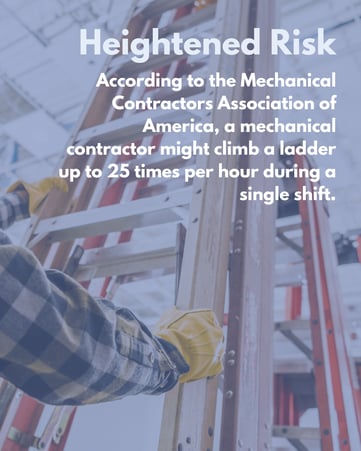
Over a building’s lifespan, maintenance access has a major impact on both safety and operating costs. With UFAD, technicians can lift floor panels to check diffusers, inspect connections, or adjust airflow — all without
ladders, scaffolding, or disruption to occupied spaces. For building owners and facility managers, the benefits are clear: faster service, fewer disruptions, lower maintenance costs, and a safer working environment for maintenance staff.
This repetition compounds fatigue and inefficiency over the course of a shift. Adjustments that might take hours with overhead systems can often be completed in minutes with UFAD.
Beyond reducing ladder-related hazards, UFAD systems also contribute to a more organized and predictable work environment. When HVAC components are located under the floor rather than overhead, technicians avoid congested ceiling spaces filled with electrical wiring, lighting fixtures and structural elements. This eliminates the need for costly lift equipment and minimizes exposure to fall hazards, which remain a top concern for OSHA compliance.
UFAD also improves workflow efficiency during both initial installation and any potential maintenance. Tasks can be performed at floor level, reducing fatigue and repetitive strain injuries associated with climbing. This ergonomic advantage translates into fewer workplace injuries and higher productivity for maintenance teams.
From a financial perspective, the reduction in safety incidents and downtime delivers measurable savings. Fewer accidents mean lower insurance premiums, reduced liability, and less disruption to building operations. For developers and owners, these benefits compound over time, making UFAD not only a safer choice but also a cost-effective one.
In an era where building performance and occupant well-being are paramount, UFAD stands out as a solution that aligns safety, sustainability, and operational excellence. Choosing UFAD is an investment in both people and long-term building value.
But one of UFAD’s most practical advantages is also the simplest: keeping work grounded. By minimizing ladder use during installation and ongoing maintenance, UFAD systems help reduce risk, improve safety, and support more sustainable building practices.
For architects, engineers and developers committed to creating high-performing environments that protect the people who build and maintain them, underfloor air distribution is a safer, smarter foundation to HVAC design. To learn more about how UFAD systems can improve safety and performance in your next project, contact AirFixture today.

1 min read
Air conditioning legal requirements in the UK are put in place to ensure the health and safety of occupants in commercial buildings. Property...
1 min read
In HVAC (Heating, Ventilation, and Air Conditioning) systems, Air Handling Units (AHUs) and Fan Coil Units (FCUs) are crucial components that play...